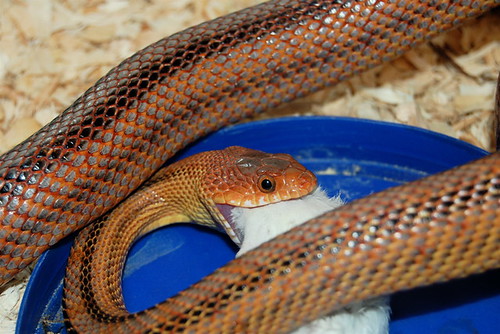
A snake named Piss-Boy
Sunday, March 23, 2008 at 8:54 PM • Herp Collection

Piss-Boy I named him “Piss-Boy,” awkwardly, after a character in History of the World, Part I: one day shortly after I got him, I noticed he’d soiled his cage four times in the six hours since I had last cleaned it. It always made it problematic to use him in reptile shows, when kids would ask what his name was.

He was an adult male Red-sided Garter Snake, one of four Jeff brought in for me in early 2000, along with two Wandering Garter Snakes (one of which, Extrovert, I still have) and a Checkered Garter Snake that died later the same year from an internal parasitic infection. May 12, 2000: that’s when I took possession. He was at least three years old at the time; fully grown. I don’t think he’s done any growing since then: his metabolism was geared for activity and reproduction.

Continue reading this entry »

Another by-law update
Tuesday, March 11, 2008 at 9:08 PM • Herp Collection, Pontiac

My presentation in front of the town council tonight might have gone better if I had known beforehand the origins of the list of banned animals — and if I’d known that the current (circa 2005) by-law also prohibits boas and pythons. Oh, hell. I still think I did all right in front of somewhat skeptical councillors, but I would have liked to have done better.

The bottom line is that there will not be any limits on animals other than dogs and cats, but they’ll think over my proposal to use the provincial restrictions instead of the municipal list. About which I’m not optimistic. We may have to divest ourselves of our two boas and one python, which, all things considered, I can manage. Could have been a lot worse — as I said, we won’t have to move.

It may well have been better not to have addressed council tonight, but what’s done is done.

Previously: A brief by-law update; My response to the Pontiac MRC animal control by-law.

A brief by-law update
Thursday, March 6, 2008 at 7:36 PM • Pontiac, Reptiles and Amphibians

Some news about the by-law situation I mentioned before; I don’t want to jump the gun and announce anything before next week’s town council meeting, but things look reasonably positive at the moment. I may not get absolutely everything I want, but it looks like we won’t be forced to choose between moving and getting rid of all our animals.

Study on deliberate reptile roadkill
Sunday, February 17, 2008 at 9:11 AM • Reptiles and Amphibians

Depressing news from the Green Bay Press-Gazette on a Canadian study regarding intentional reptile roadkill: “According to researchers E. Paul Ashley of the Canadian Wildlife Service, Amanda Kosloski at the University of Western Ontario and Scott A. Petrie at the Long Point Waterfowl and Wetlands Fund in Ontario, nearly 3 percent of drivers intentionally crush snakes and turtles on roadways.” I’m not sure I agree with the conclusion that people are resistant to public education campaigns; I rather suspect that the turtle crossing road signs in eastern Ontario have had at least some impact. Or at least I need to believe that they have.

My response to the Pontiac MRC animal control by-law
Saturday, February 16, 2008 at 8:02 AM • Pontiac, Reptiles and Amphibians

As I mentioned earlier, the Pontiac MRC is planning a new animal control by-law. It has come up with a draft for each of the 18 municipalities to approve. I have laid hands on a copy of that draft, in all its typo-ridden glory, and made a PDF of it; you can download it here.

It’s the kind of law that makes dedicated animal lovers nervous because it makes illegal activities that have been going on for a long time, and that may be perfectly legal elsewhere. Reptile keepers are used to these sudden changes in fortune — though not, as you will see from this entry, in Quebec. But in addition to restricting animals that are legal elsewhere in Quebec, the by-law would also ban dangerous dog breeds — something that is only starting to happen in larger city centres — and fix a maximum limit of five animals per household. Not five dogs or cats. Five animals. You can see where this is going.

When I first heard about the by-law, I freaked. But once I got my hands on the draft, I was able to see how I might be able to address my concerns without going ballistic, mobilizing public opinion or waging a media campaign. So I drafted the following letter, and sent it to my mayor:

Continue reading this entry »

A collection update: dying, moving, freaking out
Wednesday, November 21, 2007 at 8:28 PM • Herp Collection

We lost another snake last week, which was unexpected: Jennifer found the male hognose snake dead in his cage. He’d been an inconsistent eater, and had been moved into a separate cage to see if that would help his appetite; he had, however, been eating again. Not sure what got him — clearly the inappetance was a symptom of something — but we discovered it too late to do a necroscopy.

On a happier note, almost every snake (and turtle) that was going to be moved into a new cage is now in their new digs; they all seem to be enjoying the additional room. It took some doing to get enough locks, but, as promised, the boa constrictor, bullsnakes and black pine snakes are now in their new enormous cages. The box turtle is now in the pine snakes’ old cage; the gray rat snake is in the female bullsnake’s cage; and the ball python is in the boa constrictor’s old cage. The male bullsnake’s old cage is now being shared by the male Okeetee corn snake and the Great Plains rat snake; meanwhile, the female blue-striped garter snake has moved in with the female red-sided garter snake. They’re getting along so far. Pretzel, my original female corn snake, is now on her own, away from Trouser’s wayward hemipenes, and the remaining garter snakes previously inhabiting five-gallon tanks are now in larger digs. And the female Cape gopher is now in the gray rat’s old cage. (I think that’s it.)

Moonlight, my male California kingsnake, is even more psycho lately: at his last feeding time, he refused his meal, preferring instead to strike at us through the glass. In the more than eight years I’ve had him, he’s never been this belligerent. (Nibbly, yes, but not angry.) Gonna have to keep an eye on him, in case this is symptomatic of something.

Snake room update
Thursday, November 8, 2007 at 12:32 PM • Herp Collection

I know what you’re thinking. You’re thinking, “Never mind all this telescope shit, Jon — what about your damn snake collection? Tell us something new about that!”

Well, all right then.

New cage unit

Here’s our new — and fricking heavy — cage unit. This has been planned for years, and was ordered months ago. Little Ray’s built it; custom cage construction is one of their side gigs.

Once the paint fumes dissipate a bit, and we install the locks on the sliding glass doors, the unit’s new tenants will be as follows: one boa constrictor, two black pine snakes, and two bullsnakes, all of whom could stand bigger digs than they currently have. Once they’re in their new cages, other snakes will move into their old digs, and so on, and so on, so that even the small snakes who’ve outgrown their small cages will get an upgrade. All part of the plan I made a couple of years ago. It’ll probably take the rest of the month to get everybody moved, though.

And then there’s this, also from Little Ray’s:

New acquisition

We don’t buy very many snakes nowadays, but we made an exception for this young male Cape Gopher Snake (Pituophis catenifer vertebralis), born earlier this year. We have an older female that we bought last year, and have foolish breeding plans for the two of them. (Foolish in that expecting any success in snake breeding, given our luck lately, is rather foolhardy.)

Keeping breeding pairs together
Monday, October 8, 2007 at 7:59 AM • Reptiles and Amphibians

Claire asks, “Do you ever keep your breeding pairs together all year round? Does this seem to cause any problems?” For the most part I do, although reptile keeper conventional wisdom suggests otherwise.

The rule of thumb is that keeping breeding pairs separately increases the chances of reproductive success when you do put them together. It’s part of the conditioning process, like hibernation: it apparently makes them more eager and receptive. Of course, many reptile keepers prefer to keep their snakes separately regardless of whether they’re breeding them. While that’s a full discussion in and of itself, it’s relevant in that introducing breeding pairs for brief periods is frequently done in that context.

I’m a dissident in that I will keep snakes two or three to the tank in the first place: I keep siblings and breeding pairs (or trios) together, and I have been known to keep compatible snakes of different species together (so long as they’re similar in terms of size and habitat, won’t eat each other, and are the same sex so that they won’t hybridize). But, when I had a breeding pair of Wandering Garter Snakes, I kept them separately, because they’re cannibalistic. Introducing them for breeding purposes worked: they were interested in screwing one another, rather than eating one another. (I’ve had worse luck with kingsnakes in that regard.) With other snakes that have little to no risk of cannibalism — such as my corn, pine, gopher and garter snakes — I frankly couldn’t be bothered. They’re kept together, and they breed if and when they feel like it.

Most of the time they do breed; my problem of late has not been one of interest, but of fertility — I’ve seen a lot of bad eggs over the past two years. Personally, I think hibernating them is far more important to breeding success than keeping them separately. Especially since keeping them separately can impede breeding success in at least one scenario: your snakes may be interested in breeding, but not necessarily at the moment you’ve put them together. If you don’t make sure they’re together during their breeding window, you don’t get eggs.

Pretzel’s bad eggs
Friday, August 3, 2007 at 12:38 PM • Herp Collection

You may recall that Pretzel, one of my corn snakes, laid 17 eggs back in May. If they were going to hatch, they would have hatched by now. But they haven’t: they all went bad, one by one, over the course of their incubation.

Fortunately, Pretzel is showing no signs of laying a second clutch, so at least she won’t be wasting all that energy and body mass again — at least not this year. I must remember to get her away from Trouser before the next mating season: I meant to this year, but Trouser took advantage of my procrastination. With two years of nothing but bad eggs, and poor fertility the year before, it’s clearly time to give this pairing a rest.

On ringneck snakes, difficult species and expertise
Tuesday, July 31, 2007 at 5:30 PM • Reptiles and Amphibians

Mike Fedzen writes to damn the Ringneck Diary — my abortive attempt to chronicle our attempts to keep Southern Ringneck Snakes (Diadophis punctatus punctatus) in captivity in 2003 — with faint praise:

I found your little project with ringneck snakes doing an internet search. It was interesting, a little.
You made it seem too difficult to keep ringneck snakes, that’s for sure. I’ve worked with ringneck snakes for over 10 years … I am basically a professional. Basically. I have bred them, and kept many many specimens successfully. My longest kept specimen was an almost 10 year albino northern ringneck snake captive.
You picked southern ringneck snakes. In my experience, they are EASILY the most easily kept sub-species. They feed on worms, FISH, frogs, lizards, snakes, and will switch onto mice easier than you can imagine. Try guppies if you don’t have worms. Southern ringneck snakes in my experience have the largest menu out of all sub-species. I’ve gotten many specimens on mice scented with fish/worms/frogs … basically anything with slime.

Continue reading this entry »

Releasing baby snakes
Monday, July 30, 2007 at 8:49 PM • Reptiles and Amphibians

One problem with catching snakes in the wild and bringing them home as a pet is that some of them are live-bearing (such as garter, brown, red-bellied and water snakes), and many of them are pregnant when caught. What, then, do you do with the babies? A reader named Chantal asks whether they can be released back to the wild from which their mother came.

My answer is a qualified yes — but there are three very important caveats.

Continue reading this entry »

Snake evangelism is easy
Sunday, July 15, 2007 at 9:55 PM • Reptiles and Amphibians

Imagine if your door-to-door Christian evangelist types never had to go door to door. Imagine if all they had to do was sit at home, relaxing, and wait for people to come by to ask them about the baby Jesus.

That’s what it’s like with snake keeping: when interested people find out that you have them, they come to you.

We just had four people — the neighbour’s older son and three of his friends — over for an hour showing them our collection. It was kind of spontaneous: they were out back and decided to ask to see the snakes. And we took four people who were, at best, ambivalent to a little bit interested and, after about an hour, had them all at least touching the snakes, and two of them doing an awfully good job at handling them — and one of them muttering about getting one himself.

It doesn’t always go that well, but the people who knock on your door asking to see snakes are, at least, self-selecting.

(I need to mention — as I do in my reptiles FAQ — that we don’t make a habit of offering tours of our collection. We’re not a zoo. We knew these people, so we were happy to oblige, but we’d generally like our evenings to ourselves, thank you very much.)

Why I like boa constrictors
Monday, July 9, 2007 at 11:56 AM • Herp Collection

I’d be hard-pressed to pick a favourite snake from my collection, but it’s not hard at all to figure out which snake is the most popular with our guests. It’s Snuggles, our four-year-old male boa constrictor.

Deb and Snuggles I’ve always been leery about giant snakes, but I’ve been very satisfied with Snuggles so far. Four years ago, when we got him, we figured that if we were going to start doing reptile shows, we needed to have a large boa or python. Burmese pythons are tame but huge (full-grown pythons can weigh as much as a person), and other giant species, such as anacondas or reticulated pythons, have quantifiably evil temperaments. Boa constrictors are a lot smaller than the others, but they’re also a lot tamer and a lot safer. Bottom line, I wanted a snake I could lift; I once had to do a show with a forty-pound, nine-foot Burmese who was sweet enough, but a bit much to pick up and maneuver with. (Yes, I’m weak.)

Continue reading this entry »

Feeding a snake outside its cage
Monday, July 2, 2007 at 9:33 PM • Reptiles and Amphibians

Brien Rocha writes:

I was wondering if you are supposed to take the snake out of its cage and switch it to another to feed it, then put it back in its own cage. Any thoughts?

The short answer is, it depends.

There are two reasons not to feed a snake in its own cage:

1. There is a chance that the snake could ingest some of the cage bedding when it eats. This is obviously not a problem when the snake is kept on newspapers or paper towels, but it’s more of a risk when it’s kept on sand, bark or wood chips. If that stuff gets blocked in the snake’s digestive tract — snakes can’t digest plant matter, for example — then the results could be fatal. (Now, we keep a lot of snakes on aspen shavings, and we do feed them in their cages, but we use a dish or tray to present the mouse, and keep an eye on them to make sure they don’t swallow any shavings. For the most part, this is more of a problem with stickier food — worms or fish — or with stickier cage bedding.)

2. It shares its cage with another snake. In that case, there’s danger that they might each grab the same food item at the opposite end from one another and, well, keep swallowing once they meet. I’ve had to separate garter snakes that grabbed opposite ends of the same worm, for example. You just don’t want the snakes to eat each other by accident. Yes, they’re dumb enough to do that — there are reports of snakes that have tried to swallow themselves!

There are drawbacks to taking a snake out of its cage to feed it, but they’re much less severe — certainly nothing fatal. An easily stressed-out snake might not want to eat after being disturbed. A snake that associates the cage being opened with feeding might decide to bite the hand that reaches for it. And, well, you have to wait for it to finish: this is a problem if you have a lot of snakes, and it’s a problem if the snake takes a while to get around to eating.

Worst case of blue balls ever seen on a garter snake
Wednesday, June 13, 2007 at 6:57 PM • Herp Collection

When dealing with snakes, you tend to assume that there is only one prickly end. But I had a bit of a surprise this afternoon when we were changing the cage of Piss-Boy, my male red-sided garter snake. While handling him, I experience a sharp prick came from the other end: the little bugger was everting his hemipenes — the ends of which are rather knobby, it would appear. Pricked by his prick, as it were — or at least one of them: snakes (and lizards) have two.

Poor guy: while he’s sired 92 baby garter snakes in his time with me, he hasn’t had any since July 2001. And when he’s in the mood to mate, he makes quite a spectacle of it: courtship takes weeks, and he doesn’t eat for months; he gives constant attention. I presume that a couple of the female garter snakes in the snake room are madly exuding pheromones, which is what has set him off. Unfortunately, the only female garter snake of the same subspecies in our collection is his daughter (from the 2002 litter). So he will have to, um, deal with it somehow.

Putting the culture into herpetoculture
Thursday, June 7, 2007 at 11:02 AM • Groups and Subcultures, Reptiles and Amphibians, Site News

Three more articles are now available on this site: one is new, two are old; all three deal with the social aspects of reptile keeping.

The Art of War on the Online Forums was my editorial for the September 2000 issue of The Ontario Herpetological Society News: it was a response to the flaming and nastiness on what was then the most popular reptile board, at least among my reptile-keeping friends and colleagues. I tried to parse out some of the more common causes for antisocial behaviour. (Since then, there has been an abundant literature on moderating online misbehaviour, but if it existed then, I wasn’t aware of it.)

How Volunteer Organizations Work — And Why They Don’t, my December 2000 editorial, was me using my bully pulpit to make a point about the OHS. A club needs to earn its membership: you can’t expect people to join your club without giving them a good reason to, I argued. It was a warning against inertia. Prescient, I suppose, because the OHS folded a few years later, pinned between volunteer burnout and membership indifference.

How to Write an Article for a Herp Society Newsletter is so new it hasn’t seen print yet: Bob will probably publish it in Chorus, the OARA’s newsletter, in the fall; I couldn’t wait that long, so here it is. In it, I identify some of the more common mistakes I’ve seen reptile hobbyists make when trying to write newsletter articles. As a newsletter editor, I always wanted more articles, but getting people to write them was hard. Getting good articles was harder.

There is a reason for posting these articles: I plan on doing some more writing on the theory and practice of amateur herpetological societies. Given how far behind I am on all my projects, I can’t say when I’ll have more to say on this subject, though.

A reptile expo in Kemptville
Monday, May 28, 2007 at 9:31 PM • Reptiles and Amphibians

Jennifer and Jennifer The folks behind the Ontario Reptile Expo (hi there, Grant) had their second Ottawa-area show in Kemptville yesterday: they changed locations to the local arena, which I promptly forgot until I arrived at the empty former location. It’s the wrong season for me because the colubrids I’m interested in have yet to hatch — most animals for sale were lizards, boas or pythons — so at least we came home unscathed with only a big bag of aspen shavings and a whole whack of photos. The main reason for attending such events is social (much to the vendors’ chagrin, I think).

I’ve never seen such wide aisles at a reptile show: usually the vendors’ tables are packed in so tightly that if people are stopped at a table on each side the aisle is completely blocked. Nice to be able to circulate.

Pretzel lays 17 eggs
Friday, May 25, 2007 at 6:26 PM • Herp Collection

17! I’ve been breeding snakes since 2001, and though I’ve managed to see a live birth, I’ve never once been able to catch an egg-laying snake in the act of, well, laying eggs. Today that changed: we came downstairs this morning and caught Pretzel in the act of laying eggs in her nesting box, which was a clear plastic deli container (so we could see in). We could see how long it took an egg to pass the cloaca, and how long it took the next egg to pass down from its oviduct. I didn’t time it, but it takes a long time. In fact, the whole process took most of the day. A short while ago, we took her out, palpated her to make sure she was done, and counted the eggs.

She laid 17 of them. That’s a record. Normally, her first clutch, which is usually laid some time in May, is around 13 eggs. Why so many this time?

Continue reading this entry »

A quick snake update
Friday, May 18, 2007 at 7:29 AM • Herp Collection

Pretzel has had her pre-egglaying shed, so we should have corn snake eggs by the end of the month.

Extrovert ate normally last night. Apparently last week’s nightcrawlers were just the thing to kick-start her appetite.

The gopher snakes are off their feed, but it’s been cold lately, and they’re notorious for losing their appetite in response to temperature changes. The female has a better excuse: we found an infertile egg in their cage yesterday. A nesting box was quickly added in case more are forthcoming.

Lazy frog monitoring
Thursday, May 10, 2007 at 2:15 PM • Field Herping

It’s nice to be able to do frog monitoring without leaving your house. Spring peepers have been calling like mad for a while, but last night they were joined by American toads (whose calls started weakly but strengthened throughout the evening) and later by gray treefrogs (which were fewer in number). Three species, identified without even having to go outside.

Amphibian monitoring is important: FrogWatch Canada, FrogWatch USA, FrogWatch Australia.

A healthy — and noisy — frog population is a good sign of a healthy environment, I think, and if this is true, we’re doing well out here.

Last week, for example, I actually spotted a leopard frog on Main Street: I couldn’t bend to grab it, but I loomed over it to encourage it to hop across the road to the park. We’ve found toads and green frogs in our yard. The neighbour’s son has caught green frogs in the creek. Jennifer spotted a wood frog along the PPJ trail two years ago; last month we also saw them — and heard them — on Robert and Marilee’s property. We hear peepers frequently, even in town, spring and fall.

That’s a total of six species either seen or heard without too much effort. We have yet to see or hear bullfrogs, mink frogs, pickerel frogs or western chorus frogs — these last two species are quite rare, though; the first two we’ve seen plenty of elsewhere.

Female snakes, off their feed
Wednesday, May 9, 2007 at 10:42 AM • Herp Collection

Pretzel, my female corn snake, is visibly pregnant. She’s also in shed, and she refused to eat last night. She usually eats during shed (unlike some other snakes), but she goes off her food just before egg-laying, so I guess we’re probably a couple of weeks away from her first clutch. Right on time: she usually lays in mid-May. Time to stock up on vermiculite and get the incubator ready.

Extrovert, my female wandering garter snake, has skipped her last few meals. That’s atypical — for a non-gravid female garter outside of hibernation, it’s almost unheard of. So I’m starting to get a bit concerned. She’s definitely not gravid: she hasn’t seen a male in five years. We’ll try fish, but I wonder whether she’s about to suffer the same problem that killed one of my Butler’s garters last year. I should palpate her. She’s eight years old, which is not ancient for her species.

Previously: More evidence of an early mating season; A garter snake update.

Update, 4:45 PM: We just offered Extro three nightcrawlers, which she just snarfed right down. Possibly the garter snake reset button in action again.

Recent photography
Saturday, May 5, 2007 at 10:15 AM • My Photos, Railroads, Reptiles and Amphibians

Occasionally, I leave my house and take pictures.

Some photos from a walk with Robert and Marilee on their property two weeks ago (Jennifer’s photos).

Photos from the Ottawa Central’s open house last Saturday (see my post on FRN). It was raining, at times heavy, and my kit lens got all spotty towards the end.

Also from last Saturday, photos from our first visit to Little Ray’s Reptile Zoo in years. For this one, I put away the spotty kit lens and used my new 50-mm f/1.8 prime lens, which, you may recall, has to be manually focused with a D40. I shot without a flash, which made for very shallow depths of field (f/1.8, ISO 1600), but I’m quite pleased with the results.

LOLSNAKE!!!1one
Thursday, May 3, 2007 at 9:18 AM • Fun, My Photos, Reptiles and Amphibians

This whole thing with image macros and variants on lolcatslolruses, gebrils (NOT sic), even lolbrarians and loltrek — and the associated mangled grammar is probably on the cusp of lameness, so why don’t I help it along with my own particular … idiom. Presenting LOLSNAKE!!!1one

The water snake succumbs
Tuesday, April 3, 2007 at 11:11 AM • Herp Collection

Northern Water Snake (2003) Some of you may be aware that I used to keep a Northern Water Snake. (Yes, I had a licence for her.) She was born in captivity, and was astonishingly handleable and even ate mice, so she was a breeze to keep. She was also an amazing asset at educational displays: most people around here are deathly afraid of water snakes, which at their most basic are simply big garter snakes adapted to a diet of aquatic animals (if water snakes are feisty when caught, so too are large garter snakes). So a tame water snake was very, very useful.

When I moved to Quebec in 2003, I couldn’t keep the snake — provincial law does not allow for the keeping of protected species by private individuals — so I passed her over to a friend, who promptly got a licence for her.

You can see where this is going, can’t you? The owner wrote to say that the water snake was found dead last night. She would have been seven years old, which is kind of young for a water snake, but not excessively so. She almost certainly was carrying the same heavy parasite load in her lungs that, you may recall, killed so many of my other garter snakes. (The culprit, you may remember, was live — or at least whole — fish that carried those parasites.) That she held out as long as she did says something about her — or her species’ — resistance to big internal worms: she was almost certainly the last or next-to-last snake that was fed the contaminated batch.

Cats, snakes and emotional impact
Tuesday, March 27, 2007 at 7:16 PM • Cats, Herp Collection

In the comments on my last photo of Maya, Mike offered his condolences on our loss, to which he could relate, having had to put a cat down last year. But, he wrote,

It wasn’t quite the same when one of my corn snakes died after clutching though. How do you find it emotionally when one of the garters kicks off, or have you been fortunate enough to avoid that?

Regular readers of this blog — all six of you — will know, of course, that I’ve had more than a few garter snakes expire on me. Here’s what I wrote back:

I agree that it’s not quite the same (much as I’d like to pretend otherwise), but it was still a bit wrenching when a garter snake I’ve kept for years dies after a protracted illness, which has happened at least three times: to my female red-sided garter, who died of a liver tumour; to my male wandering garter, who died of a worm infestation; and to one of my Butler’s garters, who died from eggbinding.

I’m attached to all my animals, even the ones with little or no social interaction (i.e., the reptiles). But while I have to admit that there is a stronger emotional bond with a cat than, say, a corn snake, I’m still affected when I lose a reptile. Even if I’m not affected as much.

Either way, I feel a strong sense of responsibility: if I’m going to keep animals — especially exotic, wild animals — in captivity, I have a duty to ensure their health and, inasmuch as their little reptile brains can comprehend it, their happiness. When they die, I feel as though I’ve fucked up, even if they’re dead from natural causes or old age.

Bullsnake breeding
Sunday, March 25, 2007 at 8:45 PM • Herp Collection

Bullsnake Both our bullsnakes are growing like mad and badly need new digs. The plan was to put them in a new cage together, because we were planning to breed them this year, but we haven’t gotten the new-cage project off the ground yet. But if the other critters are any indication, time’s a-wasting, so we introduced the male and female bullsnakes for the first time this afternoon. Only a little mating activity (some tail wagging, some male-on-female biting), but no hardcore action yet; we’ll give them more opportunities later.

Bill 184 and herps in captivity: a first approximation
Wednesday, March 21, 2007 at 3:22 PM • Nature, Reptiles and Amphibians

This entry is about the potential impact of Bill 184, An Act to protect species at risk and to make related changes to other Acts, which was introduced yesterday in the Ontario Legislature, on the keeping of native reptiles and amphibians in captivity in that province. Some of what follows may have application beyond that, but bear in mind that my focus is deliberately limited.

Bill 184 does affect the legality of keeping native reptiles and amphibians in captivity in Ontario, especially if the species in question are listed as endangered, threatened or, to a lesser extent, species of special concern on the list of Ontario’s species at risk. In general, the new Act parallels the existing prohibitions and requirements of the current Fish and Wildlife Conservation Act, 1997 (1997, c. 41), but is more restrictive on several points.

The text of the bill is available online as a PDF file. Follow along as I go through some of the details.

But before I go on, a disclaimer: this is based on a quick first look. And, while I’ve worked as a paralegal and am comfortable looking at legislation, I am not a lawyer and anything I could say about this bill could be totally wrong. Don’t base any decisions on what I write here.

Continue reading this entry »

New endangered species legislation in Ontario
Tuesday, March 20, 2007 at 1:43 PM • Nature, Reptiles and Amphibians

New endangered species legislation introduced today in Ontario; see also backgrounder and notice of proposal. The text of the bill does not seem to be available yet.

It will be interesting to see if this new legislation will have any impact on reptile and amphibian keepers above and beyond the Fish and Wildlife Conservation Act, 1997, which has done double duty as a kind of species protection act to compensate for the quite-dated endangered species legislation last updated in 1984, but which does, I think, a journeyman’s job of regulating human interactions with sensitive species. (Penalties under the FWCA for killing, capturing, or selling protected species have a stiffness equivalent to other endangered-species laws.)

The main issues appear to be questions of land stewardship, habitat protection and the mechanism by which status is evaluated — none of these is addressed by the FWCA.

If anything, I expect changes to differentiate between levels of endangeredness, above and beyond what has already occurred in the regulations. See the list of species at risk in Ontario.

I’ll follow up when I have a chance to look at the bill itself.

More evidence of an early mating season
Sunday, March 11, 2007 at 5:02 PM • Herp Collection

You may recall that I had decided to retire Pretzel as a breeder, and planned to move her to a separate cage before breeding season. Well, heh heh, you know, a funny thing happened: breeding season came about six weeks early, before I’d gotten around to moving her out. Trouser pounced on her on March 3. (Apologies for the late report: I’ve had a bit of a week.) I’ve never seen it earlier than April — but then I’ve never gone without hibernating them before. You’d think that not hibernating them might depress the libido, but apparently corn snakes have other ideas. Now what?

No pictures of the event; I’ve got enough photographic evidence of his (and other snakes’) prior copulatory shenanigans.

Previously: Black pine snakes, giving us something to talk about.

Black pine snakes, giving us something to talk about
Monday, February 26, 2007 at 7:56 AM • Herp Collection

Without question, the snakes in our collection that generate the most questions about potential offspring are the black pine snakes. I’m sure that if I kept better track I’d have quite the waiting list by now. If they produced lots of babies, I’d sell every last one, and at a healthy price, too. Unfortunately, they only produced a single viable clutch, and that was back in 2002; the clutch produced last year turned out not to be viable. I’ve always wondered why we haven’t been able to replicate our success.

Black pine snake mating activity Now yesterday we caught the two pine snakes in the throes of mating activity. I didn’t actually catch — or photograph — the actual act of intromission, but Lucifer certainly seemed to be trying, and was performing several stereotyped courtship behaviours as well. Fine and good — but it’s late February, which seems a little early. In past years, they were hibernating at this time, in separate containers. I wonder if our mistake — the reason why we’ve had such poor reproductive success — is because we’ve been hibernating them through their mating season?

Snake massage, anyone?
Wednesday, February 7, 2007 at 7:22 AM • Reptiles and Amphibians

An Israeli spa offers snake massages, where, for 300 shekels, clients get to have six snakes crawl across their bodies. Of note, the spa is Israeli but the snakes are the usual North American pet species:

Barak uses California and Florida kingsnakes, corn snakes and milk snakes in her treatments, which she said were inspired by her belief that once people get over any initial misgivings, they find physical contact with the creatures to be soothing.

This is something that can be arranged, you know. Photos here; via Boing Boing.

Snakes, eating
Tuesday, January 2, 2007 at 3:27 PM • Herp Collection

Further to my previous report: the last two stubborn feeders, a male eastern garter snake and a male albino checkered garter snake, ate with relish this afternoon. Jennifer scented the fuzzies’ heads with worm goo, and the checkered garter had been given additional heat. Which means that every single snake that went off its feed in the fall is now eating again. (Only they didn’t go off all at once: in September it was the glossy, gopher and hognose snakes; by the time they started eating again in October, some of the male garter snakes stopped eating. As I said, all eating just fine now.)

Cobra on the loose
Monday, November 27, 2006 at 10:12 PM • Reptiles and Amphibians

Holy shit. In Toronto, an Egyptian cobra has been on the loose for two months, forcing tenants out of two houses and their landlords to go without an income during that time. The cobra was one of three venomous snakes kept illegally by one tenant; the other two — another Egyptian cobra and a gaboon viper — have been seized, and the owner is due in court on Friday.

Every so often one of my young snake keeping friends has their pet snake escape. Usually it turns up again within a couple of weeks; it’s usually no big deal, because they live in single detached houses and the snakes are harmless: it’s mainly a question of the snake’s safety, not anyone else’s (and escaped snakes can survive for months).

But there’s a big difference between a corn snake on the loose and a venomous snake on the loose, especially when the keeper is living in an apartment.

My position is as follows:

  1. You should never let snakes escape. If your snake escapes, it’s your fault. QED.
  2. You should never let snakes escape if you live in an apartment or undetached dwelling. If your snake escapes and turns up in someone else’s apartment, you’re in a lot of trouble.
  3. The legality or morality of keeping venomous snakes notwithstanding, if you live in an apartment or undetached dwelling, you should never keep venomous snakes. Ever. If you do, and your venomous snake escapes, you’re fucked.

I never have and never will keep venomous snakes. Even so, I haven’t had an escape in more than four years, and I’ve never completely lost a snake — I’ve almost always found the snake out of its cage rather than an empty cage. I’m proud of that fact.

Eat, snakes!
Friday, November 17, 2006 at 10:00 PM • Herp Collection

Good news on the snake feeding front tonight:

  • Recalcitrant garter snakes were offered fish fillet; all but one ate.
  • Newly acquired baby corn snake ate without having to be confined.
  • Longtime anorexic leucistic Texas rat snake ate a frozen/thawed mouse.

Virtually every snake that went off its feed earlier this fall is eating again. The garters are not back on mice, but that shouldn’t take long. Stinky poo in the meantime.

A garter snake update
Tuesday, November 7, 2006 at 8:33 AM • Herp Collection

Most of the recent news about our reptile collection revolves around garter snakes.

For the most part, the recalcitrant feeders are eating again, but most of the male garter snakes continue to be stubborn. I did not note differences in feeding enthusiasm in my article on the differences between male and female garter snakes, but I’m beginning to think that males might be more prone to go off their feed. Certainly there are Darwinian reasons for females to eat, eat, eat, eat; males can get by at a level much closer to subsistence. Piss-Boy, my male red-sided garter, went two months without eating in the fall of 2000 — he was too busy humping the female I’d just introduced him to. Priorities.

Continue reading this entry »

Exclusive Dragons stole my photo!
Tuesday, October 24, 2006 at 9:22 PM • Reptiles and Amphibians

The dumbasses at Exclusive Dragons are using my photo of my Baird’s rat snake to sell one of theirs. I’ve sent e-mails to them and to the site’s webmaster. If it doesn’t disappear right quick they’ll be in serious trouble.

Baird's Rat Snake in mid-shed Reptile hobbyists take a perverse pleasure in stealing one another’s photos. Here’s a primer for mine. They’re all copyrighted: you don’t need a notice or a watermark for that. They’re also licensed under a Creative Commons Licence: that means that you can use them freely so long as you (1) identify me as the photographer and (2) don’t use them for commercial purposes. By using the photo in a classified ad without crediting me as the photographer, Exclusive Dragons broke both rules. But not only does Robin Moniz steal other people’s photos without credit, this individual also is using a photo of one snake to sell another, and that’s dishonest. Would you buy a reptile from such a person?

Besides, I believe I saw their snake for sale at the reptile expo in Kemptville this month, and it was hardly in “excellent” condition. I’ve been looking for a female Baird’s rat snake for years, and I passed that one up — what does that tell you?

Update, 9:48 PM: The offending ad has been removed (thanks Grant); I have screenshots if you’re interested.

Update, 10/25: Robin has apologized; she claims a mixup in photos on the hard drive (between photos-of and favourites-downloaded).

Appetite
Wednesday, October 18, 2006 at 8:46 AM • Herp Collection

More snakes are finding their appetite again (see previous entry). The female hognose snake and both Great Basin gopher snakes ate their mice like good little snakes last night.

Meanwhile, many of the garter snakes have been refusing meals here and there. This is a known issue, and I’m not overly worried about it.

Pinkies and acquisitions
Monday, October 16, 2006 at 11:34 AM • Herp Collection

After some tweaking of room temperatures and feeding methods, some of our recalcitrant feeders are starting to eat again: the leucistic Texas rat snake took its first mouse in two months, and the male hognose snake is back on his feed. (The others haven’t been tried yet; their next feeding is forthcoming.)

The new Okeetee corn snake was being stubborn about it too, but confinement — essentially, stuffing the little snake in a film canister with a pinky mouse — is working well: she’s eaten twice by that method. I’m confident she’ll be taking mice more enthusiastically, and without assistance, before long.

Acquisitions continue: yesterday we picked up a lovely juvenile female Cape Gopher Snake (Pituophis catenifer vertebralis), with plans to find a compatible male ASAP. She’s in quarantine with the Okeetee right now. I should take her picture or something; cape gophers, if you don’t already know, are stunning.

Other acquisitions are in the works, and will be announced once they’ve arrived.

Snake Tracks, spammers
Wednesday, October 11, 2006 at 5:10 PM • Internet, Reptiles and Amphibians

Eight messages (so far) doesn’t exactly constitute a bombardment, but new reptile site Snake Tracks has been sending me automated e-mail at virtually every address they can find on the Internet (addressed in some cases to “Librarything” or “Feedburner,” so you know they did their homework) — asking, as usual, for a link exchange. You know what that means: if someone asks you for an “exchange,” it’s all in their favour — they need it more than you do.

And, as it turns out, Snake Tracks is yet another generic set of reptile forums, with hardly any members (only 28 so far) or other original content. (A ball python care sheet and a species list? That’s it? Are you kidding me?) There are about four zillion other reptile sites just like it out there. And they call themselves the “World’s Largest Snake Enthusiast Website” — which is not only laughable, it’s demonstrably false.

(Hint: Spamming me isn’t a good way to get a positive review.)

Snakes in autumn
Monday, October 9, 2006 at 10:17 AM • Herp Collection

An update on our collection.

After four passes with Vapona (see previous entries), we’re tentatively declaring our collection mite-free.

I mentioned that we’ve been thinking of taking Pretzel off the breeding treadmill. Those plans are now more concrete: she’ll be put in a separate cage before mating season starts up again.

If we’re going to breed snakes, we need to increase the pool of breeders; if we’re not going to breed snakes, we should really scale back from what we have. We’ve decided, therefore, to get a few more corn snakes, with the eventual goal of having several pairs breeding at any one time. That should take care of pet store demand, provide enough variety, and provide insurance if not every pair is fertile. Jennifer has started this process; last weekend she picked up a hatchling female Okeetee corn snake, to pair up — eventually — with our two-year-old male. But it’ll be at least three years before any offspring comes of that pairing. We’ll probably get three or four more corns; we haven’t figured out which varieties, yet.

Falling autumn temperaturers caught us off-guard a bit, and several snakes have entered hibernation mode: the glossy snake, the gopher snakes and the hognose snakes have all gone a month without eating. I expect they’ll restart at some point, and am not yet overly worried: these gophers and hognoses are notorious for going off their feed from time to time.

Radiated rat snake
Saturday, September 23, 2006 at 8:51 PM • Reptiles and Amphibians

Radiated rat snake. Photo by Nicole LaBarre Our friend Nicki has acquired a Radiated Rat Snake (Elaphe s.l. radiata). Here are some things that have been written about the temperament of this species.

Bartlett and Bartlett, Corn Snakes and Other Rat Snakes (1996): “When even vaguely threatened, the radiated [rat snake] (so-called for the three dark lines that radiate outward from the eye) pulls is neck back, inflates its throat, and vigorously defends itself.”

Schulz, A Monograph of the Colubrid Snakes of the Genus Elaphe Fitzinger (1996):

The snake is very fast if it becomes necessary to flee and shows an amazingly aggressive temperament if cornered: The front part of the body is inflated vertically, bent into a double S-shape, and lifted off the ground. With the mouth agape and short hissing sounds, it literally leaps at the aggressor who may even [be] pursued for some distance. If the snake is picked up, it often empties its bowels and bites[;] the bitten part is often chewed on for a while.

Not for the faint of heart! Which is to say, me. (Nicki knows what she’s doing, though.)

Introducing Snakes on Film
Friday, September 22, 2006 at 5:23 PM • Movies, Reptiles and Amphibians

Snakes on Film is my latest project. It’s a look at how snakes are used in movies and television — whether they’re accurately portrayed, and which species are being used. Think of this as a nitpicker’s guide for reptile enthusiasts. History buffs have had great fun picking apart historical movies; science fiction geeks love pointing out errors in continuity. Now it’s the snakes’ turn. Five posts up so far, with five more in the immediate queue. (Yes, Snakes on a Plane is forthcoming; that was the movie that finally set this project in motion.)

Dry bite
Friday, September 15, 2006 at 9:46 AM • Reptiles and Amphibians

A bite from a venomous snake that does not inject any venom is called a “dry bite.” Sometimes a venomous snake withholds its venom when it bites in self-defence, saving it for prey — venom is primarily a means of subduing and pre-digesting prey, and only secondarily a self-defence mechanism.

Someone who receives a “dry bite” is called a “lucky bastard” — and that certainly applies to the unnamed 26-year-old Barrie, Ontario man who received a dry bite on Tuesday from a friend’s saw-scaled viper, which he had reportedly been poking at. Indian River Reptile Zoo curator Bry Loyst, who manages the Ontario Antivenin Bank, was rushed to the hospital in Barrie with some antivenin as a precaution. See news coverage from the Barrie Examiner, Globe and Mail and Toronto Star.

Saw-scaled vipers, which range from Africa to India, are both extremely irascible and extremely toxic: they kill a lot more people than some of the more glamorous snakes in their region, like cobras, if not more than any other species on the planet. You may remember the incident six years ago with the guy in Toronto whose venomous snake got loose, generating national headlines? Same species.

An egg update
Wednesday, September 6, 2006 at 7:47 PM • Herp Collection

No black pine snakes this year; all the eggs have collapsed. (Some looked fine until you turned them over.) Oh well.

Steve Irwin Schadenfreude
1 Wednesday, September 6, 2006 at 2:22 PM • Reptiles and Amphibians

The worldwide reaction to Steve Irwin’s death has been swift, strong and usually sympathetic, but it’s inevitable that some people are insufficiently socialized that they cannot help but take a shot at the recently departed and the circumstances of his death.

Jason Calacanis says that the Discovery Channel killed him because of its focus on televising risky encounters with wildlife; Germaine Greer says that the stingray attack was the animal world extracting its revenge. The sentiment behind these posts occurs elsewhere, and can be distilled into one of two arguments: Steve Irwin was an irresponsible thrill seeker; Steve Irwin was a cruel tormentor of animals. Either way, it’s poetic justice — in other words, he got what was coming to him — and the commentariat, whether in the op-ed pages or on the blogosphere, thrives on poetic justice the way it revels in Schadenfreude.

My response to those espousing these arguments is simple. You have no idea what you’re talking about.

Continue reading this entry »

Crikey!
1 Monday, September 4, 2006 at 10:44 AM • Reptiles and Amphibians

A few years back, a rumour would start going around the Internets every so often that Steve Irwin had, honestly for sure really this time, gotten himself killed doing the things that Steve-o does. The rumours were always bunk. So my first response was to disbelieve the report, which I first saw on a reptile mailing list. But this time it’s true: Crocodile Hunter Steve Irwin was killed this morning by a freak accident with a stingray.

No matter how careful you are, no matter how outside the risk is, it’s never the animal’s fault. Irwin would be the first to say so.

From the Guardian’s story, I learn a new word: “larrikin” — loosely, a maverick or wild-spirited person — which is how Australian Prime Minister John Howard described Irwin. He was also, as the tributes have noted, one of Australia’s biggest ambassadors, though I’m given to understand that many were just a mite bit embarrassed by him and his “fair-dinkum” schtick. Which, apparently, wasn’t a schtick at all.

Never mind Australia: he was the best ambassador that the unloved animals of the world — my kind of animals — ever had.

He was a crazy bastidge, and we need more like him.

The motherf***ing snakes on Snakes on a Plane
Friday, September 1, 2006 at 9:08 PM • Movies, Reptiles and Amphibians

So, Snakes on a Plane. Saw it Tuesday night, and I’m finding myself in agreement with Kent Williams’s review in the Madison, Wisconsin Isthmus:

The movie’s neither good enough nor bad enough to leave much of an impression. Director David Ellis does seem to have gotten the memo about camping it up, but perhaps not as early in the filmmaking process as some would have liked. And so the movie kind of careens between Airport (with snakes) and Airplane (with snakes), genre and genre parody. Itching to get things started, Ellis lets his snakes — all 400 of them — out of the cargo bay much too early, passing up any chance for suspense. And most of them are so clearly digitized, you feel like you’re watching a cartoon.

That it was self-consciously over the top was what made it watchable; that its over-the-top scenes were so scattershot was what made it disappointing. You can tell where the gratuitous language, nudity and gross-out scenes were added: without them, the movie would have been more earnest, less fun, and just plain mediocre — it would have been a forgettable, low-budget bomb.

Even so, the character development and writing were profoundly weak; we needed Samuel L. to come alive more, to inhabit his typecast bad-ass persona more — in other words — say the 12-letter M-word more — in order to breathe more life into this film. As it stands, you can see the plastic surgeon’s scars.

But never mind that shit. What about the motherfucking snakes?

Continue reading this entry »

Mites, eggs and hibernation plans
Tuesday, August 29, 2006 at 5:41 PM • Herp Collection

We’re just finishing up the second mite treatment for the collection: after four days, we’ve removed the dichlorvos and are putting the water dishes back in. We’ve found quite a few dead mites in some of the cages, plus, I’m afraid, one small live one, in the ball python’s cage. This means that we’ll almost certainly have to do a third treatment. I suspect that the first dose (see previous entry) wasn’t long enough (it was three days instead of four), and the gap between it and this, second treatment was too long as a result of the vacation in the middle of it (they should be two weeks apart; it was three). Note for future reference. But we are killing mites — hopefully faster than they’re breeding. Cross your fingers.

Continue reading this entry »

Mites, cleaning cages, and a reptile keeper’s secret weapon
Sunday, August 6, 2006 at 10:27 PM • Herp Collection

We spent today recovering from yesterday, when, as part of our collection-wide treatment for snake mites, we cleaned every reptile cage in the house — all 34 of them.

We’d been on guard for mites for a while, since a snake that had been passed between our collection and a friend’s turned up with mites a while back (it doesn’t really matter who gave who mites, and it’s impossible to tell in any event), but we were reluctant to begin the treatment until we had definite confirmation that mites were present at our end. We only confirmed mites — on three snakes — a week ago today, which set the treatment process in motion.

Continue reading this entry »

Black pine snake eggs!
Thursday, July 13, 2006 at 12:30 PM • Herp Collection

Black pine snake eggs I wasn’t sure whether Lilith, my female black pine snake, was going to lay eggs at all — she doesn’t every year, and she’s usually the last to do so — but she’s laying eggs right now. Look!

Of course, there’s no guarantee that the eggs will be fertile; she’s laid slugs before. Cross your fingers.

Reptiles at Risk
Wednesday, July 12, 2006 at 8:14 PM • Reptiles and Amphibians

Jeff Here’s what I’ve been working on lately: Reptiles at Risk. My friends at Sciensational Sssnakes!! have done road trips before, but this time, thanks to some external funding, they’re kicking it up a notch. Beginning this summer (actually, beginning last Monday), they’re embarking on several multi-province tours to bring the message of reptile conservation to small, rural communities that would not normally be host to reptile shows, but that are also host to populations of threatened or endangered reptile species. As usual, I’m doing the site; it’s mostly done now (I think the IE-specific bugs are taken care of), but there are likely to be further refinements and embellishments as we go.

‘An open mind, an open heart, and a smooth, blunt, lubricated probe’
Monday, July 10, 2006 at 1:39 PM • Fun, Reptiles and Amphibians

Watching a rerun of The Colbert Report the other day, Jennifer and I ended up laughing ourselves senseless over this bit, which combines the gay marriage debate with reports that a woman in India had married a snake, and takes it into very strange territory …

Of course, part of the reason we were laughing so hard is because Colbert is actually describing the right way to sex a snake. We were pointing at the screen and screaming: “Ahhh! He’s actually doing it! Oh god oh god oh god.” (Gasp. Breathe.)

When you’re snake people, it’s not something you expect to see, you see. Wow.

Infertile bullsnake eggs
Thursday, June 29, 2006 at 7:23 AM • Herp Collection

Infertile bullsnake eggs I wasn’t planning to breed our bullsnakes before next year, but the female had other plans: she laid two infertile eggs in the water dish overnight. In the water dish, because snakes like to lay eggs in moist places, and snakes who aren’t given nesting boxes — e.g., snakes who’ve never mated — frequently pick the water dish to deposit their eggs. That, or they get egg-bound.

This bodes well for next year, but I was really hoping for some nice, fertile black pine snake eggs. (Cross your fingers: Lilith is looking squishy and has been given a nesting box.)

Corn snake eggs collapsing
Monday, June 26, 2006 at 8:11 AM • Herp Collection

Meanwhile, our corn snake eggs are collapsing. I’m not sure whether it’s simply because Pretzel is no longer very fertile, or because we’re doing something wrong in our incubator. We (by which I mean Jennifer and I) may well have to have Kim over here for a consultation!

Necroscopy report
Thursday, June 1, 2006 at 6:10 PM • Herp Collection

Jennifer performed a necroscopy on the Butler’s garter snake last night to find out what killed her. From what I can tell, it’s something completely different from what I anticipated.

To be sure, the snake died from starvation. That was the direct cause. There was no fat and very little muscle left; the snake had metabolized it all. But the reason for starvation was that something was blocking her gastrointestinal tract: with a compressed stomach, she had no desire to eat. At first she stopped eating mice, but continued to accept earthworms. Then, at the last, she refused earthworms: the blockage was too large even for worms.

But what was the blockage? What was the cause of the hard lumps I felt along her abdomen? I suspected organ tumours, based on her advanced age. Alternatively, I worried that it might be fecoliths — hardened fecal matter in the intestinal tract — which, unlike tumours, were both preventable and treatable (so if she died from it, it would be my fault). It turned out to be neither.

Continue reading this entry »

Another Butler’s garter update
Wednesday, May 31, 2006 at 8:23 AM • Herp Collection

The Butler’s garter I referred to in previous entries (here and here) has now died. She had refused to eat earthworms over the weekend, which just does not happen with this species, so we knew her time had run out.

We’ll do a necroscopy this evening and find out what killed her.

Overall, though, I’m neither disappointed nor embarrassed (unless the necroscopy shows that we fucked up somehow). Six years is an extremely good run for this species, three times as long as the record. And the remaining Butler’s garter is still going very strong — she’s the big, hungry one who likes to bite.

At some point I should write an article on the long-term care of this species.

Pretzel lays eggs
Wednesday, May 24, 2006 at 7:27 AM • Herp Collection

Thirteen of Pretzel’s eggs are now residing in our incubator; she is now her usual gaunt and hollow post-deposition self. For some reason, her first clutch is almost always 13 eggs.

The eggs should hatch in late July; assuming no complications, the babies will be available after they’ve eaten three consecutive meals of frozen/thawed pinky mice — probably no earlier than late August, unless they decide to be stubborn.

Butler’s garter update
Monday, May 15, 2006 at 6:33 AM • Herp Collection

Dept. of Not Dead Yet. The problematic Butler’s garter snake (see previous entry) still has a bit of life left to her: she ate two nightcrawlers last night. (Sometimes, snakes that do not normally eat mice but have been trained to do so will, at certain points, refuse to eat mice but will continue to eat their original food; more about that here.)

Geriatrics and Butler’s garter snakes
Friday, May 12, 2006 at 10:17 AM • Herp Collection

Butler's Garter SnakesI’ve had two female Butler’s garter snakes (Thamnophis butleri) in my care since October 2000. They were only a few months old at the time, which means they’re now approaching six years of age. That’s nearly three times the record of two years in Slavens (which is no longer being updated), and I’m quite proud of being able to keep them alive for this long.

I’ve been wondering when we might start running into geriatric health issues with these snakes. Larger garter snakes can easily pass 10 years (Piss-Boy is at least nine), but smaller natricines seem to have shorter lifespans — Storeria’s record, for example, is somewhere between four and seven years — so Butler’s garters might be similarly short-lived.

Continue reading this entry »

Pretzel is definitely gravid
Friday, May 5, 2006 at 7:51 AM • Herp Collection

Pretzel, our breeder female corn snake, refused to eat last night, and she’s definitely carrying eggs. She usually lays in mid- to late May, so she’s right on schedule. She still looks a little thin, though; I wish we could have gotten more mice into her. I shudder to think how hollow she’s going to be after egg deposition.

Hognose snakes feeding again
Friday, April 28, 2006 at 7:48 AM • Herp Collection

For the first time since coming out of hibernation in early March, earlier this week both hognose snakes ate the food they were offered. The male had eaten once before; the female hadn’t. Neither was looking particularly gaunt or had anything else visibly wrong with them; I can only surmise that they simply weren’t ready to come out of hibernation yet. Both, however, had shed shortly either the night before or the day before they were offered food this time, so maybe they need a post-hibernation shed before they start eating. (Note for future reference.)

Now let’s see if they’ll breed!

Corn snake breeding activity
Friday, April 14, 2006 at 8:51 PM • Herp Collection

Our corn snakes tend to start with the courtship and the breeding and the carrying-on in mid-April, and this year is no exception: they were making a right spectacle of themselves last night. On schedule.

A post-hibernation update
Sunday, April 2, 2006 at 6:53 AM • Herp Collection

Between the date you bring your snakes out of hibernation and the date your female snake lays its first clutch of eggs (or has its first litter, if it’s a live bearer), the challenge is to get as much food into that snake is possible. For most snakes with healthy appetites, that’s not a problem, but there are some exceptions.

For example, my female Great Basin gopher snake has gone off her feed for extended periods during the summer — she’s from a Canadian bloodline, so I think she’s aestivating when that happens. In her case, it seems that hibernation actually helps her appetite, though.

Continue reading this entry »

Out of hibernation
Wednesday, March 15, 2006 at 4:02 PM • Herp Collection

All of our breeding snakes — the corn snakes, the Great Basin gopher snakes, the black pine snakes and the western hognose snakes — are now out of hibernation. They were down for a little longer than usual — nearly four months — as an experiment to see whether it would help. On the other hand, we weren’t able to maintain low temperatures in our basement: I’d been hoping for 12-15°C, and got 17-18°C instead. We’ll see how it turns out.

We only wish to catch a fish, so juicy-sweet!
Sunday, January 29, 2006 at 10:41 PM • Herp Collection

It’s the middle of winter and two of our garter snakes — the smaller of our two Butler’s garters and our male plains garter — are turning up their noses at mice. This sometimes happens during the winter. So we’re offering them fish fillet, for now. I imagine they’ll start eating something healthier in short order, but in the meantime the implications are … smelly. Or at least they will be in a day or two.

When biologists play at grammar
Sunday, December 4, 2005 at 11:52 AM • Language, Reptiles and Amphibians

A couple of weeks ago, I got the following question from Craig Sommers: “I recently received a comment from a Fish & Wildlife Service biologist who said that ‘garter snake’ is now one word for all common names. True?”

As I wrote back, the answer is a bit complicated, but his question reminded me that I’ve been thinking about this question for several years now. It’s a really arcane and insignificant question: whether snake names are one word or two — i.e., “garter snake” or “gartersnake.”

This little essay has been gestating in my mind for several years, but I’ve been putting it off because I didn’t think I knew my grammar enough to write with any authority. In the end, though, I figure it’s worthwhile — inasmuch as this whole subject is worthwhile, which is kind of debateable — to put out what I know and what I think, and leave the corrections to another time.

Continue reading this entry »

Two more reptile-related photosets
Monday, October 17, 2005 at 12:21 PM • My Photos, Reptiles and Amphibians

Belated photo update: I’ve created two new photosets on my Flickr account. This one is a selection of photos from an impromptu OARA field trip two weeks ago; this one is a collection of photos of my snakes engaged in the horizontal mambo. By far my most popular photos on Flickr are a couple of closeups of my corn snakes doing the nasty, presumably due to people using “graphic sex” as a search term, and getting grossed out by the results. Well, tough; here are some more.

On a related note, there are two Flickr groups roughly equal in size with roughly the same mandate: Herp Photography, which I started about a year ago, and Reptiles and Amphibians. Duplication inevitably happens with user-created groups on community sites, but it’s rare to see two of equal quality that do equally well. I wonder if we should consolidate, assuming that we even can.

How many snakes?
Sunday, September 11, 2005 at 4:36 PM • Reptiles and Amphibians

“How many snakes do you have?” That’s easily the most common question we get about our snake keeping. The number fluctuates, especially if you include the offspring we’re raising for sale, but it hovers around 40 or so permanent snakes. Right now — I just counted — we have 38 permanent snakes and seven babies being raised for sale.

The answer to the first question invariably brings us to the second question: “How can you keep that many snakes?”

The straight answer is, they don’t take up much room and their cages are stackable. This is quite true: zoo guidelines suggest that snakes be kept in cages the combined length and width of which equal or exceed the snake’s length — for example, a four-foot snake would be properly housed in a cage three feet long and one foot deep. And since we make a point of working with smaller species — about one-third of the collection is made up of garter snakes, for example — it’s not at all difficult to find the room for that number of snakes.

But people asking that question aren’t really looking for a technical answer; they’re really asking, “How (on Earth) can you (possibly) keep … ” It’s akin to being asked how you can possibly eat a disgusting food item: while saying that “I open my mouth and shovel it in” is technically answering the question, it’s not what they mean.

So I’ll try to answer the question they’re really asking.

Continue reading this entry »

Bad eggs
Monday, August 29, 2005 at 8:26 AM • Herp Collection

The gopher snake eggs went bad some time ago, and now Pretzel’s second clutch isn’t looking viable: most of the eggs have collapsed.

I wonder if these girls are simply getting too old? Unfortunately, I didn’t get them as hatchlings, so I have no sure way of telling how old they are. I’ve had Tosh for four years and Pretzel for six.

Feeding time
Friday, August 19, 2005 at 11:33 AM • Herp Collection

I mentioned yesterday that the landlord’s daughter looked after our apartment when we were off in the Maritimes. She was basically housesitting for the cats, frog, turtle and fish; one of the advantages of snakes is that they can be left alone for a week or two with very little risk. She was a trooper, but a little ambivalent about the snakes. Not to worry, we said: just change their water if they foul it and make sure they have enough of it; she wouldn’t have to feed them or touch them.

But curiosity persisted, especially among those who visited with her, viz., her younger brother and her boyfriend. So on Wednesday night we invited them over to watch us feed the snakes.

Watching snakes eat is always popular, and inevitably draws crowds. It’s not just that they get a perverse thrill out of watching them snuff the life out of some inoffensive little animal, as a city official once declared to me during by-law negotiations. It’s the amazement that the snake can eat something that big, and can do it without chewing, biting off into pieces, or table manners. It’s one thing to explain how a snake’s skull is flexible and can disjoint itself in several places where a human skull is fused together, quite another to see it in action.

So of course they ate up seeing the snakes eat up, especially the rat eaters, who looked about ready to explode. The gopher snakes went off their feed again (sigh), so their adult mice were redistributed; the Baird’s rat snake got one, after his hopper mouse, and looked enormous thereafter.

But it wasn’t just the ability to eat something huge, either; it was the speed with which snakes attacked their meals. Many of these snakes don’t move around real fast otherwise, so it was a bit of an eye-opener to see them strike (and in some cases constrict) in an instant.

All in all, they were transfixed. This is the sort of thing that will make us very popular with the local kids, and quite possibly very unpopular with their mothers.

Feeding corn snake babies; more eggs
Tuesday, July 26, 2005 at 8:20 PM • Herp Collection

Enough time had passed since their hatching that it was time we tried to feed the corn snake hatchlings. We’ve had trouble getting Pretzel’s babies to eat at the outset before, but this time we were luckier: five out of six ate their first meal without difficulty. The severely kinked one — the one that Jen manually pipped — did not eat, but it had not yet shed; again, Jen had to help. It’s not unusual for snakes to refuse their meals the first few times; to have only one refuse is the best results we’ve had with corn snakes, ever.

Meanwhile, Pretzel laid another ten eggs, which look good and are now in the incubator. She looks as gaunt as she usually does immediately after deposition, but not emaciated. I was worried for a while that she hadn’t fed up enough between clutches. But all is well, I think. Now to fatten her up before hibernation.

Spotted turtle survey photos
Tuesday, July 19, 2005 at 5:39 PM • Field Herping, My Photos

Here’s something I did during my enforced time offline: I finally got the photos from the 2003 Spotted Turtle Survey online, only two years and three months late (see previous entry). I procrastinated uploading them for the longest time because I had a hard time winnowing them down. I’ve frequently had that problem when trying to pick from too many photos; I think I’m finally over that, though, because I managed to pick the 27 best photos from more than 170. And I think these photos are awfully good even if I do say so myself. (For more on the survey, see my report from the 2001 trip.)

You are number 6
Monday, July 11, 2005 at 11:38 PM • Herp Collection

It was a hot one around here today — the kind of day around here where mammals hide in the basement and snakes shit all over their cages and in their water dishes (an all-too-obvious byproduct of being fed last Friday). And one of the eggs that Jennifer manually pipped yesterday actually turned out to be viable: our sixth baby corn snake is emerging as I write. Unfortunately another kinked one, and damned if I can figure out why.

Corn snake hatching update
Saturday, July 9, 2005 at 8:05 AM • Herp Collection

Two baby corn snakes have emerged from their eggs so far.

Update (12:30 PM): Two more have emerged, one of which appears kinked in two places (damn). One still hiding in its egg, one apparently viable egg not yet pipped, the rest questionable to no good. (Incidentally, this would normally be considered a crummy clutch — only five out of 13? — but my standards are lower lately.)

Pipping now
Friday, July 8, 2005 at 9:11 AM • Herp Collection

The corn snake eggs are beginning to hatch. Two have pipped so far; none have emerged yet. It can take a few days for every snake to pip their shell and crawl out. With any luck, those that made it to this point will all be out by the end of the weekend.

Update: As of 10:40 PM, a total of five have pipped; none of them have crawled out yet. Another two eggs look good but have not yet pipped; the remaining eggs have collapsed or gone mouldy.

More eggses
Wednesday, June 29, 2005 at 8:40 AM • Herp Collection